In this story
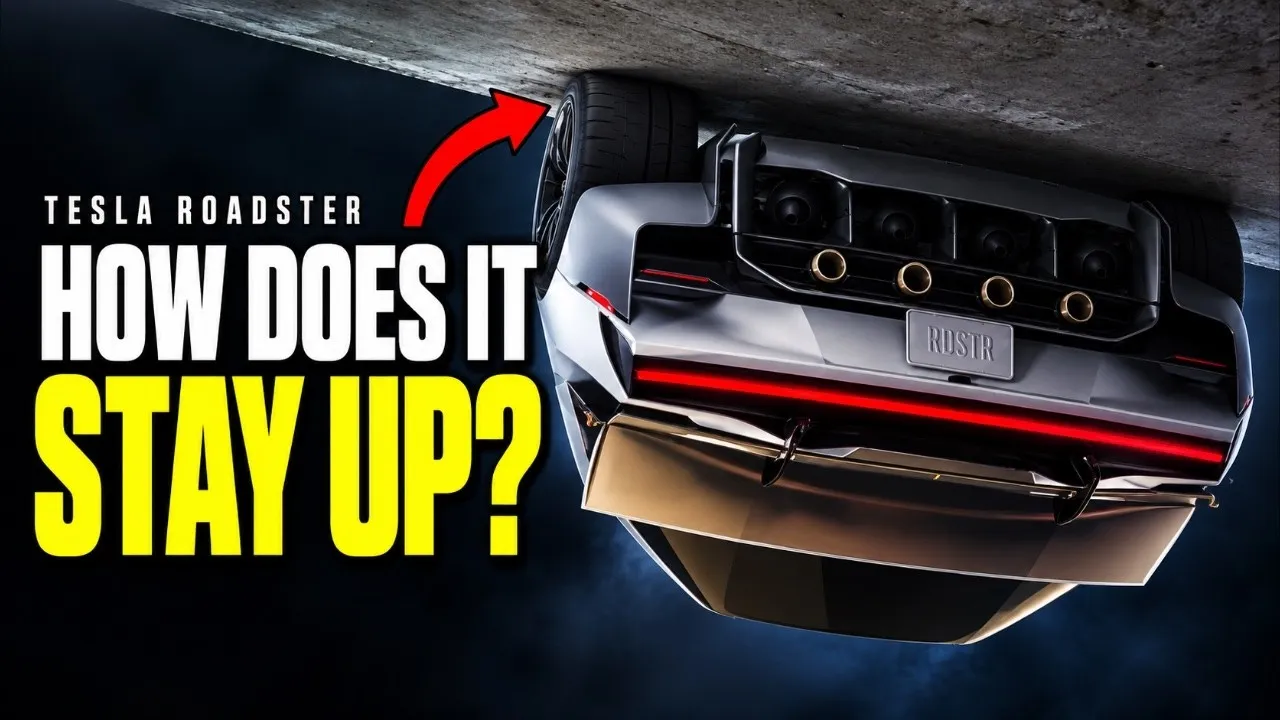
A sports car stops upside down beneath an overhang. Its tires stay against the surface. It looks nothing like normal driving, but the question behind it is a simple one: where are the forces coming from?
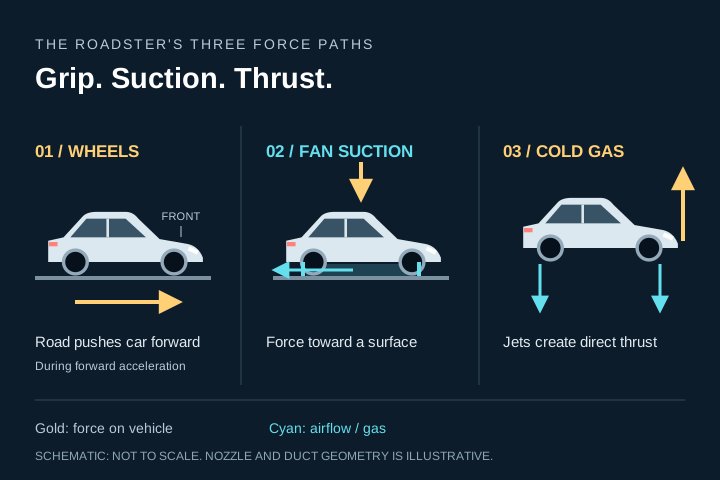
The redesigned Roadster shown at Tesla’s October 2026 event (opens in a new tab) brings together three ideas: electric wheel drive, fan-generated suction, and cold-gas thrust. They can work together, but each one solves a different problem.
Keeping them apart explains both what the demo shows and what it doesn’t. Holding a car against a prepared ramp is a very different job from holding it up in open air.
 3:46Prefer watching a video instead?Watch "How Does the Tesla Roadster Stay Upside Down? Fans, Seals and Thrusters" on YouTube. (opens in a new tab)
Start with the tires
An electric motor can deliver torque very quickly. But that doesn’t mean the car can turn all of it into acceleration.
During forward acceleration, the driven tires push backward on the road, and the road pushes them forward (opens in a new tab). That forward friction force is what moves the car. Ask for more force than the contact can handle and the tire slips. More motor power won’t fix that.
A useful first approximation is that available friction depends on the normal force pressing the tire against the surface, multiplied by a friction coefficient. Real tires are more complicated: load, temperature, compound, and surface condition all matter. Still, the basic relationship explains why adding downforce can help a powerful car use its power.
That raises an obvious engineering question. Can you press the tires down harder without adding weight the car then has to accelerate?
The fans change the pressure underneath
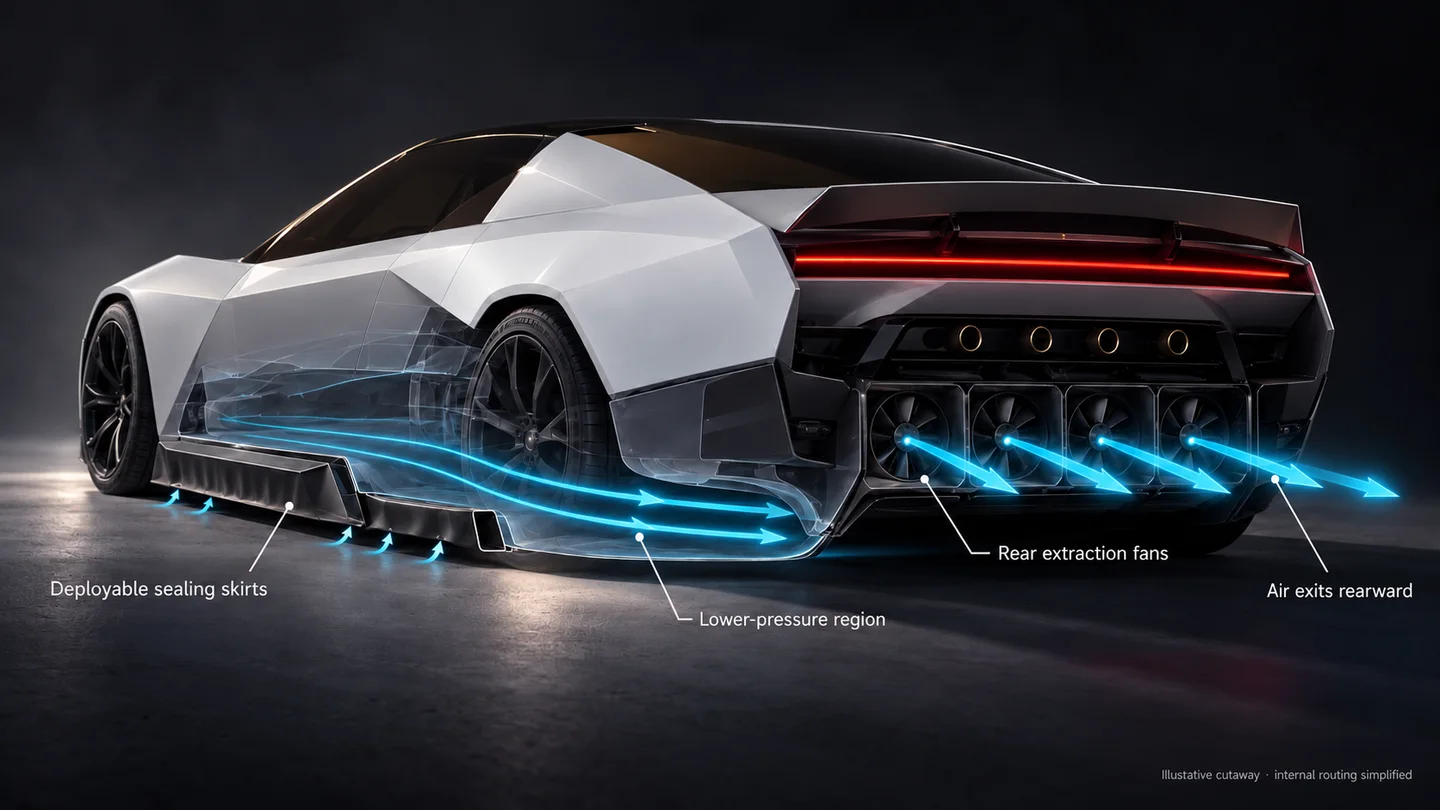
Tesla describes a fan and ground-sealing system (opens in a new tab) that pulls air from beneath the Roadster and can hold it upside down while it’s standing still. The rear cold-gas nozzles are a separate system.
Think of the underbody as a space where the fans keep the pressure lower than the air around the car. The higher pressure outside pushes the car toward the nearby surface. The air pulled out of that space has to go somewhere, so it leaves through the extraction system.
For a simplified, roughly uniform pressure difference, the force is:
Contact-directed force ≈ pressure difference × effective area.
Here’s an illustrative calculation, not a Roadster specification. A pressure difference of 5,000 pascals over 3 square meters produces 15,000 newtons, roughly the weight of a 1,500 kg car. That’s only about 5% of atmospheric pressure, but spread over a large area it adds up to a lot of force.
A normal wing only makes downforce when the car is moving through the air. A powered fan system works even when the car is standing still. The catch is that it needs power, and it has to keep leaks under control.
Why the sealing skirts matter
An open gap around the underbody would let the surrounding air rush back in. The fans would then have to move more air to keep the same pressure difference.
Flexible sealing skirts have to limit that leakage while coping with movement, bumps in the surface, and wear. That’s a much harder job than a gasket clamped between two parts that don’t move.
Tesla’s adaptive-downforce patent (opens in a new tab) describes movable skirts, flexible ground-contact elements, and operation near or in contact with the ground. It also discusses changing the skirt setup for different conditions. A patent shows what Tesla has considered, though, not necessarily what’s on the demo car.
The ramp changes which force has to resist gravity
The demonstration uses a purpose-built curved ramp leading into an overhead section. That matters: the demo doesn’t show that the car can stick to any wall it comes across.
On a vertical section, suction pushes the car toward the wall. Tire grip has to provide the upward force that holds the car against gravity, plus extra force if it’s accelerating upward. With strong suction but too little grip, the car would still slide down.
Under the overhang, things change. The suction force now points upward, directly against the car’s weight. To hold the car still upside down with the tires pressed against the surface, suction has to be greater than the weight; the surface pushes back with the rest.
The curves add one more thing. Moving along a curve requires acceleration toward its center of curvature, so speed and ramp shape affect the forces during the maneuver. Holding still upside down doesn’t tell you what speeds or surfaces are safe.
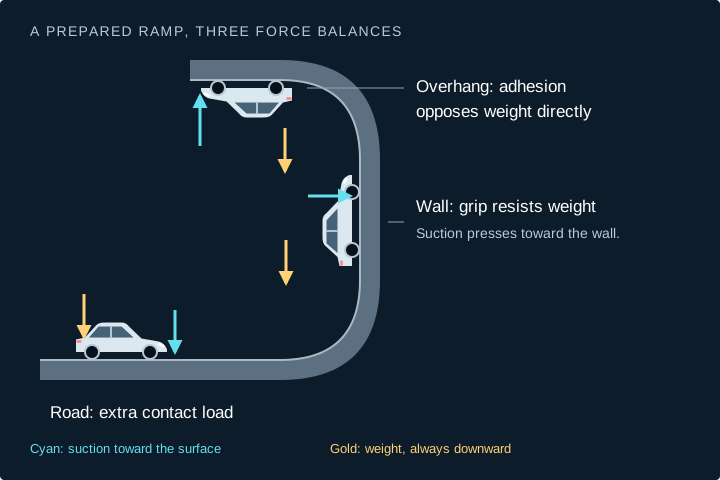
Try changing the orientation below. On the wall, watch the available tire grip. Under the overhang, compare suction with weight. Then choose open air to see why upward thrust becomes necessary.
Same car, different forces
Change the surface, then adjust the forces. These example values aren't Roadster specifications.
More contact load
The surface supports weight plus the added suction force. More contact load can increase available tire grip.
The car stays in place even when the forces can't hold it. Use the numbers to judge the balance; arrow lengths don't represent force size.
Assumptions: Uniform pressure over 3 m², a friction coefficient of 0.8 and gravity of 9.81 m/s². In open air, thrust acts upward through the center of mass.
Limits: The drawing simplifies the hardware. The model omits motion, air drag, changes in tire grip with load and control limits, so it cannot establish safe operating conditions or stable hover.
Thrusters bypass the tire contact
Cold-gas propulsion creates force by pushing pressurized gas out through a nozzle. There’s no combustion. The gas goes one way and the vehicle is pushed the other.
NASA’s thrust equation (opens in a new tab) relates thrust to the mass of gas expelled, its exhaust velocity, and the pressure difference at the nozzle exit. NASA’s guide is about combustion rockets, which differ from cold-gas hardware, but the same momentum and pressure terms explain the force.
A rearward jet can add forward force without sending that extra force through the tires. That’s different from asking the motor for still more wheel torque.
Nozzle position matters too. A force that doesn’t act through the center of mass can turn the vehicle as well as push it. Several jets working together can change the car’s attitude, but only if the controls manage both the total force and the turning effects.
Leaving the surface changes the problem
Once the car is clear of the ramp, the sealed space under the car is gone, and suction has nothing to pull against anymore.
To hover, the combined upward thrust has to equal the car’s weight. To climb, it has to be greater. It also has to keep the car from pitching or rolling out of position.
And the gas runs out. Each burst uses some of the supply, and changing tank conditions affect what the thrusters can deliver. A short hop in the air isn’t sustained flight, and it isn’t a practical way to fly over traffic.
Which version, and where can it operate?
Tesla’s current configuration descriptions (opens in a new tab) separate Performance, with suction and active aerodynamics, from Thrust, which adds rear cold-gas propulsion. Rocket adds perimeter thrusters for forward and upward acceleration and rotation. The page labels Performance road ready and Thrust race ready, and explicitly says Rocket isn’t approved for public-road use. Regional restrictions also apply.
That’s Tesla’s own labeling, not proof that the car is approved everywhere. Equipment, operating mode, and local rules all matter.
The harder engineering questions are about repeated use: how the skirts handle broken surfaces, what happens when leakage increases, how the controls respond when suction is lost, and how safely gas can be released around other people. Fans use power, sealing edges wear out, and once the gas is used up, the car can’t fire again until it’s refilled.
The upside-down ramp shows what suction and tire grip can do. The jump shows what thrust can do. To be useful outside a controlled demo, the system needs a clear operating envelope: which surfaces, speeds, durations, and failures it can safely handle.